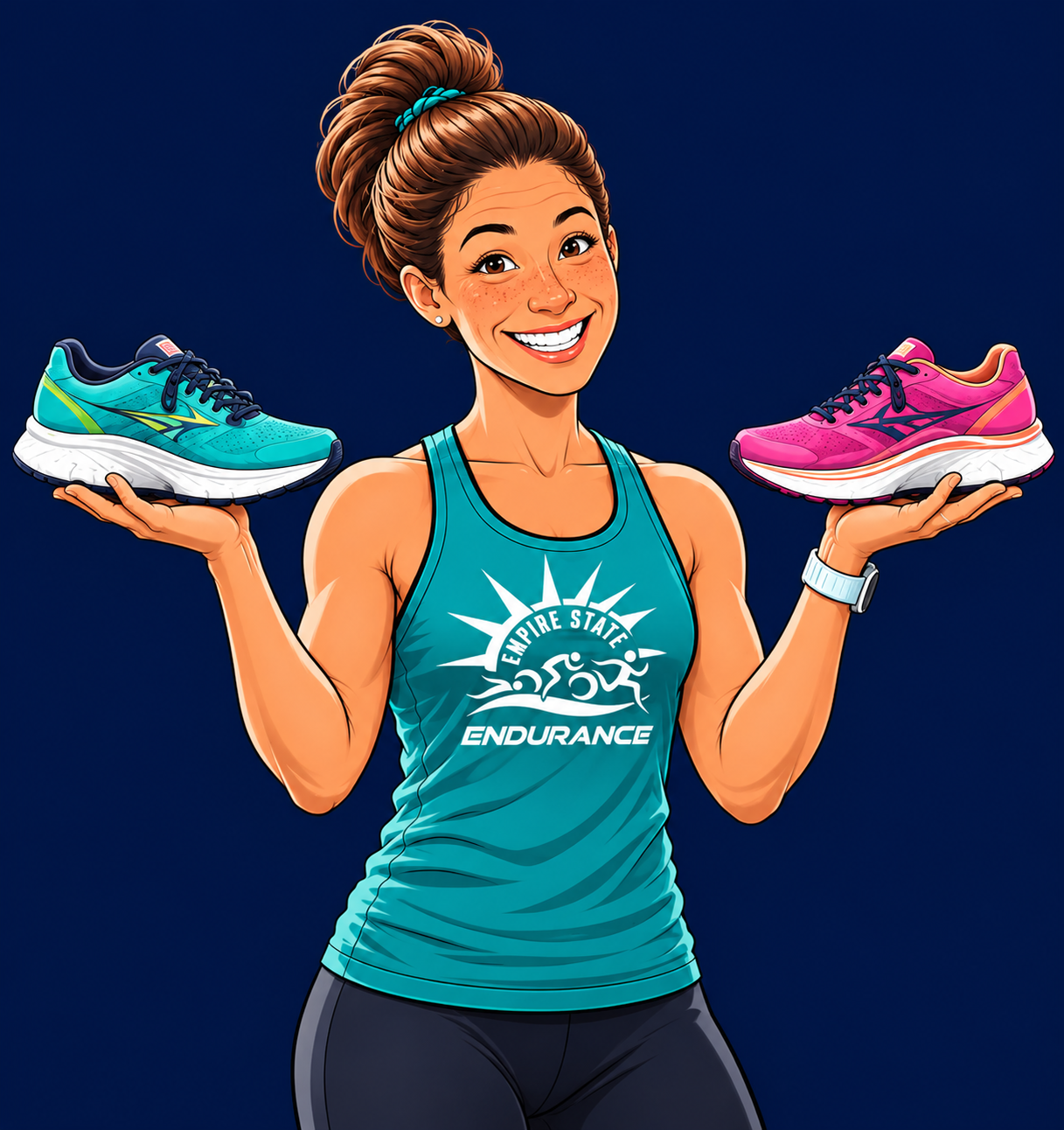

Running shoes might be one of the most confusing parts of being a runner. There are so many options, so many different technologies, and approximately a million opinions about what shoe is “best.” To cut through the noise, we asked ESE athlete, Jaime Goodman, a Certified Pedorthist and Certified Shoe Fitter with 20 years of experience in the orthotics industry and just as many years running. Jaime studied at the Robert Palmer Institute for Biomechanics before sitting for her state licensing examination in Pedorthics. Pedorthics focuses specifically on the biomechanics of the lower extremities.
Jaime has run 10 marathons including traveling all around the world as she tries to check off the World Marathon Majors. At ESE, we pick Jaime’s brain about shoes all the time, so we figured it was time to share some of that knowledge.
In this article, Jaime shares her expertise on modern sneaker technology, explaining what all those features actually mean and how to find the right shoe for your feet.
Plates, Rockers, and Drops: Sneakers, Beyond the cushion.
Whether you are training for a marathon, walking around the block, or standing on your feet all day, the shoes you wear matter. Sneaker technology has evolved, moving far beyond basic cushioning. Today, shoes are engineered with specific geometries, plates, and support systems designed to change how your foot interacts with the ground.
Understanding these technical features is the key to preventing injury and unlocking your full potential. Let’s break down the major types of sneaker tech, their pros and cons, and how to choose the right pair for your feet.
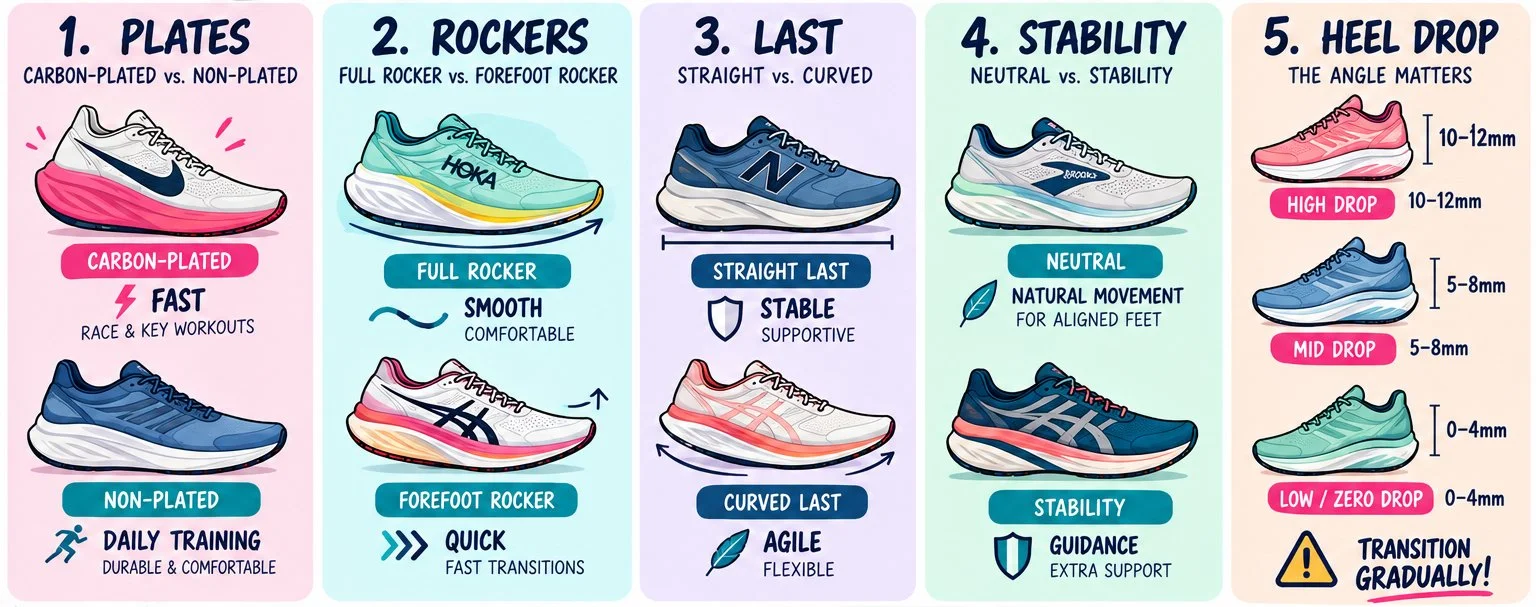
1. Carbon-Plated vs. Non-Plated Shoes
The biggest revolution in modern running footwear is the introduction of rigid plates embedded in the midsole foam.
Carbon-Plated Shoes
These shoes combine ultra-lightweight, bouncy foam with a rigid carbon-fiber plate that acts like a springboard. Examples: HOKA Cielo X1 3.0 or Nike Alphafly.
Advantages: Maximum energy return, improved running economy, and less muscular fatigue over long distances. They make you objectively faster.
Disadvantages: High cost, short lifespan (often only 150–250 miles), and an unstable feel at slower paces.
Non-Plated (Traditional) Shoes
Your everyday trainers rely solely on foam and rubber for cushioning and protection. Examples: Brooks Ghost or Nike Pegasus.
Advantages: Durable, affordable, comfortable at any pace, and safer for daily training because they allow your foot to move more naturally.
Disadvantages: Heavier and less responsive than plated models, offering less "pop" and energy efficiency when trying to run fast.
💡 The Golden Rule: Can You Train in Carbon-Plated Shoes?
The short answer is yes, but not every day. While the bouncy feel of carbon shoes is addictive, using them for all your weekly miles can alter your natural biomechanics. Because the plate does a lot of the work, training in them every day can weaken your foot muscles over time while shifting heavy loads onto your calves and Achilles tendons. They are also incredibly expensive and wear out quickly.
Limit carbon-plated shoes to 1 or 2 fast workouts per week (like interval sessions or race-pace long runs) so your body adapts to them for race day. For your everyday, easy recovery miles, stick to a durable non-plated trainer to keep your feet and ankles strong.
2. Rocker Bottoms vs. Forefoot Rockers
Traditional shoes are relatively flat, requiring your foot to actively flex to push off. Rocker shoes use a curved sole geometry to mimic the natural rolling motion of the foot.
Rocker Bottoms (Full Rocker)
The sole is curved like a rocking chair from the heel all the way to the toe. Examples: Hoka Bondi or Saucony Shift
Advantages: Greatly reduces the workload on the ankle joints, Achilles tendon, and heel. Excellent for people with plantar fasciitis, arthritis, or general foot pain.
Disadvantages: Can feel inherently unstable or awkward when standing still or walking slowly. It shifts the workload up to your knees and hips, which may cause fatigue if those areas are weak.
Forefoot Rockers
The shoe is flat under the heel and midfoot but curves sharply upward just under the ball of the foot (the toes). Examples: Asics metaspeed edge
Advantages: Accelerates the "toe-off" phase of your stride, helping you transition quickly and efficiently into your next step. Great for faster running.
Disadvantages: Provides less relief for heel and ankle pain compared to a full rocker, and requires a stiff forefoot that some walkers find restrictive.
3. Straight Last vs. Curved Last
The "last" refers to the mechanical mold around which a shoe is built, dictate the shape of the sole.
Straight Last
A straight-lasted shoe is symmetrical and flat on the bottom, filled in completely on the medial (inner) side. Example: Brooks Ghost Max
Advantages: Provides a massive, stable platform. Excellent for flat feet, heavy overpronators, and people who wear custom orthotics.
Disadvantages: Heavy, rigid, and visually bulky. It lacks the nimble, fast feel of a performance shoe.
Curved Last
A curved-lasted shoe cuts inward at the arch, mimicking the natural C-shape of a typical foot. Examples: Puma Nitro, Asics Metaspeed Ray
Advantages: Lightweight, highly flexible, and moves fluidly with your foot. Ideal for racing and agile movements.
Disadvantages: Offers very little inherent structure. If your ankles collapse inward, a curved last will offer minimal support to stop it.
4. Neutral vs. Stability Shoes
This is the most common categorization you will see on the shelves of a running store, based on how your foot rolls when it hits the ground.
Neutral Shoes
Designed for runners whose feet stay aligned or roll slightly outward (supination). They focus purely on cushioning. Examples: Asics Superblast and Brooks Glycerin
Advantages: Lightweight, highly flexible, and allows the foot to function independently.
Disadvantages: Offers no correction or guidance if your ankle mechanics begin to break down due to fatigue.
Stability Shoes
Designed for runners whose ankles roll inward excessively (overpronation). They use guide rails, dual-density foam, or plastic posts on the inside of the shoe to resist that inward collapse. Examples: Brooks Adrenaline GTS and Asics Kayano
Advantages: Reduces strain on the shins, knees, and hips by keeping the foot in a safer, more neutral alignment.
Disadvantages: Stiffer and heavier than neutral shoes. If you don't actually need the stability, forcing your foot into this shape can cause discomfort or new injuries.
5. What is Heel Drop and Why Does It Matter?
The heel drop (or heel-to-toe drop) of a shoe is the difference in height between the cushioning under your heel and the cushioning under your toes. It is measured in millimeters (mm). If a shoe has 32mm of foam under the heel and 24mm under the forefoot, it has an 8mm drop. This angle drastically dictates how impact forces are distributed through your lower body when your foot strikes the ground.
The Three Drop Categories:
High Drop (10mm – 12mm): Traditional running shoes feature a steeper slope. They favor a heel-strike running style and shift the physical stress of your stride upward into your knees and hips. Examples: Brooks Ghost, Nike Pegasus, Mizuno Wave Rider.
Mid Drop (5mm – 8mm): The modern sweet spot. It offers a more natural foot position while still providing plenty of heel protection. Examples: Hoka Clifton, Saucony Kinvara, Asics Novablast.
Low to Zero Drop (0mm – 4mm): These shoes keep your foot completely level, mimicking how you walk barefoot. They shift the physical stress of your stride downward into your calves, Achilles tendons, and ankles. Examples: Altra Torin (Zero drop), Topo Athletic, Hoka Bondi (4mm).
⚠️ The Danger of Drastic Transitions: Why You Can't Skip Steps
One of the most common causes of running injuries is jumping overnight from one extreme drop category to the other. If you have spent years running in a traditional 12mm drop shoe, your calf muscles and Achilles tendons have adaptively shortened over time because they have never been forced to fully stretch down to the ground. If you suddenly switch to a 0mm zero-drop shoe for a long run, your Achilles tendon is instantly stretched like a taut rubber band far past what it is conditioned to handle. This almost always leads to acute Achilles tendonitis, severe calf strains, or plantar fasciitis.Conversely, switching from a lifetime of zero-drop shoes straight into a high-drop shoe changes your pelvis tilt and shifts sudden, unaccustomed impact forces into your knee joints, which can trigger runner’s knee.If you want to change your shoe's heel drop, you must transition gradually. Step down incrementally (e.g., move from 12mm to 8mm for a few months, then to 4mm) to give your musculoskeletal system time to safely adapt.
Know Your Foot: The Power of a Gait Evaluation
With so many variables, how do you know which combination is right for you? It all comes down to your unique foot anatomy and biomechanics.
Feet generally fall into three categories:
Flat Feet (Low Arch): Tend to over-pronate, meaning the arch collapses inward, requiring a stability shoe or a straight last.
High Arches: Tend to underpronate (supinate), meaning the foot is rigid and absorbs shock poorly, requiring a highly cushioned neutral shoe.
Normal Arches: Generally follow a neutral gait cycle but can benefit from specific tech depending on training goals.
Why You Shouldn't Guess
Buying a shoe based purely on looks, color, or a friend’s recommendation is a fast track to injury. If you put a high-arched runner in a heavy stability shoe, you risk spraining an ankle. If you put a heavy overpronator in a highly flexible, curved-last racing shoe, they may develop shin splints or knee pain within a week.Visiting a specialty running store for a professional gait evaluation is the best investment you can make. An expert can watch you walk or run, analyze how your foot strikes the ground, and pinpoint exactly what geometry—whether it's a forefoot rocker, a straight last, or a touch of stability—will keep you moving comfortably and pain-free.
The Finish Line: Listen to Your Feet
At the end of the day, there is no single "best shoe" on the market—there is only the best shoe for you. Modern sneaker technology offers incredible tools to help us run faster, walk further, and recover more comfortably. But these features only work if they complement your body's natural mechanics instead of forcing them into a mold where they don't belong.
Before you click "buy" on that next flashy pair you see online, take a moment to evaluate what your feet actually need. Your joints, muscles, and tendons will thank you for it down the road.